
A current-version flip forward module consists of 8 printed parts, flaps, some fasteners, a small magnet and the electronics to make it all work.
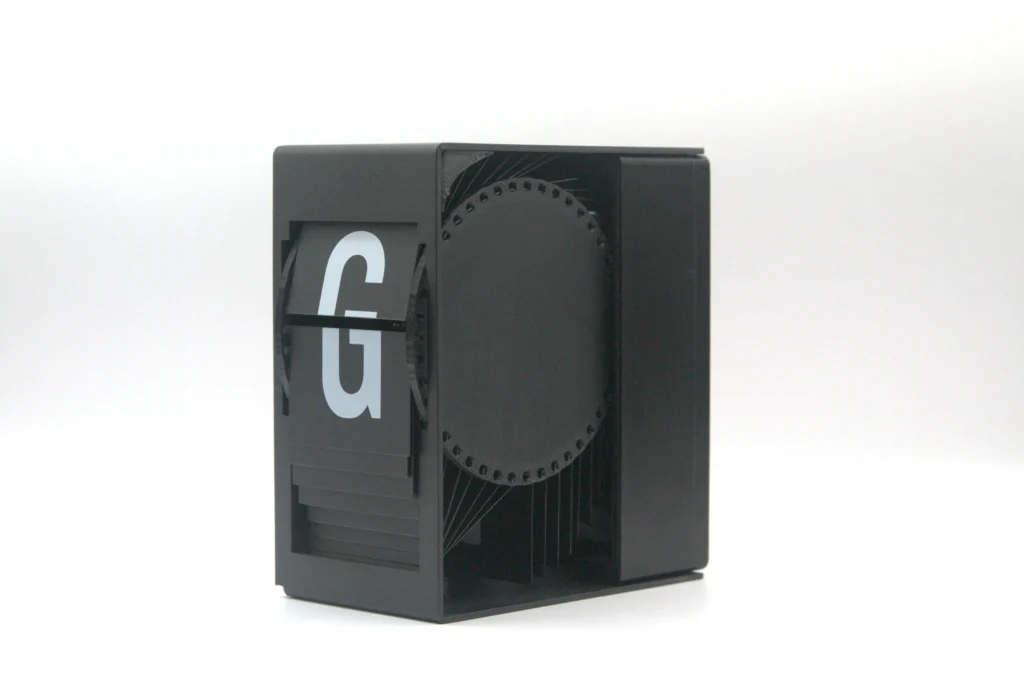
In an earlier revision, 8 printed parts was the number of parts needed for just a section of the inner gears. There’s no inner gears anymore, there’s not even gears anymore – and that’s the lesson here.
The primary difference between split flap modules and pretty much any other project I’ve done so far is that ease of printing and ease of assembly directly impact project success: If one display takes an 12 hours to print and 2 hours to assemble, it’s just not feasible to build assemblies of 5, 10 or 50 modules.
So the focus is all the time on trimming anything away that can go away – and the equation is simple: The currency is complexity – and any part, screw, move during assembly needs to earn its place by directly making the display better.
I’ll give you an example. Until recently, the main drum assembly was held together by three screws that were screwed into threaded inserts that were melted into the plastic post-printing. While that’s extremely satisfying, it’s also time consuming and you need the threaded inserts. The original value proposition was that this will make the central drum more precise – but it really doesn’t. I’ve done versions with, versions without, and now there’s no more threaded inserts. Anywhere. They didn’t pass the test – not enough value for the complexity they’re adding.
There’s a strong connection I feel to changes in the software engineering world that are mostly about removing complexity, not adding new things – and the feeling of satisfaction that comes from that is just the same in hardware projects.
Are we done making flip forward modules as simple as they can be? Almost, I’d say. And to ground ourselves back in reality, here’s the latest simplifications and improvements:
- Threaded inserts gone on the central drum and the back case.
- Unipolar hall sensor replaced with omnipolar ones – no more finding the correct side of the homing magnet (that’s a huge quality of live improvement)
- Added a small supporting flange for the 3D-Printed Front Case. helps with stability while not adding any meaningful print time.
- The BYJ Motor Adaptor got replaced with a community version that is just.. much simpler!
I’d like to thank Richie and Daniel for their comments, suggestions and helpful feedback. This shaped a lot of the above and many more improvements – especially also on the documentation side.
You’ll find all the latest parts, along the build instructions and parts preparation over on www.flipforward.de.
If you want to follow the journey here more directly, feel free to join the discord server!